👉 Let’s stay connected on social media!
How to Make Soft and Flavorful Homemade Ciabatta Bread at Home
QUICK REMINDER:
While we have provided a jump to recipe button, please note that if you scroll straight to the recipe card, you may miss helpful details about ingredients, step-by-step tips, answers to common questions and a lot more informations that can help your recipe turn out even better.
I believe that store-bought bread is a trap. Like, genuinely a scam. We all just collectively agreed that dry, weirdly uniform loaves in crinkly plastic bags were “good enough” because capitalism said so and we were tired. Meanwhile, the first time I pulled a blistered, lopsided, wildly imperfect ciabatta out of my oven, I felt like I had hacked the system and also possibly joined a very small, very floury cult.
It also feels very “post-2020” to be talking about homemade bread again, I know. We all went through the Era of The Sourdough Starter and the Great Flour Shortage and the “I named my starter Kevin” phase. Some of us never recovered. I personally took a detour into obsessive banana baking and made these chaotic little banana bread brownie things that confused everyone at my kid’s school bake sale but sold out first, so joke’s on them.
Anyway. Homemade ciabatta bread looks like it should belong to the people who own linen aprons and proofing baskets. It doesn’t. It belongs to you. Even if your kitchen is small and weird and your oven tilts slightly to the left like mine and you routinely lose your salt.
The Time I Made Homemade Ciabatta Bread That Felt Like a Yoga Mat
The first time I tried ciabatta, it came out… flat. Like emotionally and structurally. Imagine a pale, floury yoga mat with aspirations. It smelled faintly like wet cardboard and regret. When I picked it up, it made this sad, rubbery squeak against the baking sheet. That’s how underbaked and overworked it was. Terrifying.
I followed some Very Serious Recipe that screamed about hydration percentages and baker’s math and “slap-and-fold” techniques, which is, frankly, a rude phrase. The dough was supposed to be sticky “like thick pancake batter.” Mine was sticky like spilled glue mixed with anxiety. It clung to everything: the bowl, the spoon, my dignity.
The sound it made when I plopped it on the counter? A full-body splat. My dog left the room. That’s when you know it’s bad—when the creature who licks his own feet is like, “I’m out.”
I tried to stretch it like the videos showed, but it just tore, and then I got mad and kneaded it like regular bread (which you are not supposed to do with ciabatta, but tell that to my stress levels). So all the bubbles—those gorgeous air pockets that make it look holey and fancy—just… died. Rip in peace.
I baked it anyway. Of course. Because once you’ve covered your entire counter in flour and rearranged your whole schedule around a bowl of goo, you’re committed. It came out this sad, dense slab with exactly zero of the open crumb I’d been promised. The crust was weirdly chewy, like if a croissant and a rubber band had a disappointing baby.
And I kept doing it. Over and over. Adjusting the water, changing the yeast, moving the bowl closer to the oven for “warmth” like it was a small Victorian child with a cold. I’d be like, “This time I’ll nail it,” while scraping dried dough cement off my favorite mixing spoon. Spoiler: I did not nail it. Not for a while.
Honestly, if you’ve ever baked anything and then immediately wanted to throw it into the yard, you’re safe here. I’ve also done that. With cookies. Which is ironic, because I now make these obnoxiously good chocolate chip cookies that pretend the dark times never happened.
Anyway, the point is: my early ciabatta smelled like wet drywall and tasted like “I tried.”
What Finally Clicked (Sort Of)
Here’s what changed: I stopped trying to be a Perfect Bread Person and accepted that ciabatta dough is supposed to be annoying. The second I stopped fighting the stickiness and started treating it more like a feral pet than a project, things got better.
Emotionally, I had to let go of the idea that bread = knead forever. That’s what we grew up with, right? Punching dough on the counter like a stress ball. But with this homemade ciabatta bread situation, it’s more: mix, leave it alone, poke it occasionally, whisper affirmations (optional but spiritually helpful).
Practically, I simplified it. No starters. No overnight mystery bowl in the fridge that I forget about and then rediscover at 2 a.m. like a science experiment. Just flour, water, yeast, salt. Room temperature life. A dough that looks too wet, and you thinking, “This cannot be right,” and it absolutely is.
My learning curve looked like this:
- Attempt 7: still rubbery.
- Attempt 9: accidentally good, no idea why.
- Attempt 11: realized I’d been adding too much flour on the counter and suffocating the dough.
- Attempt 13: finally wrote stuff down.
And part of me STILL thinks, every time, “Well, this is the time it doesn’t rise.” It always does. It just likes to wait until I stop staring at it like a raccoon at the window.
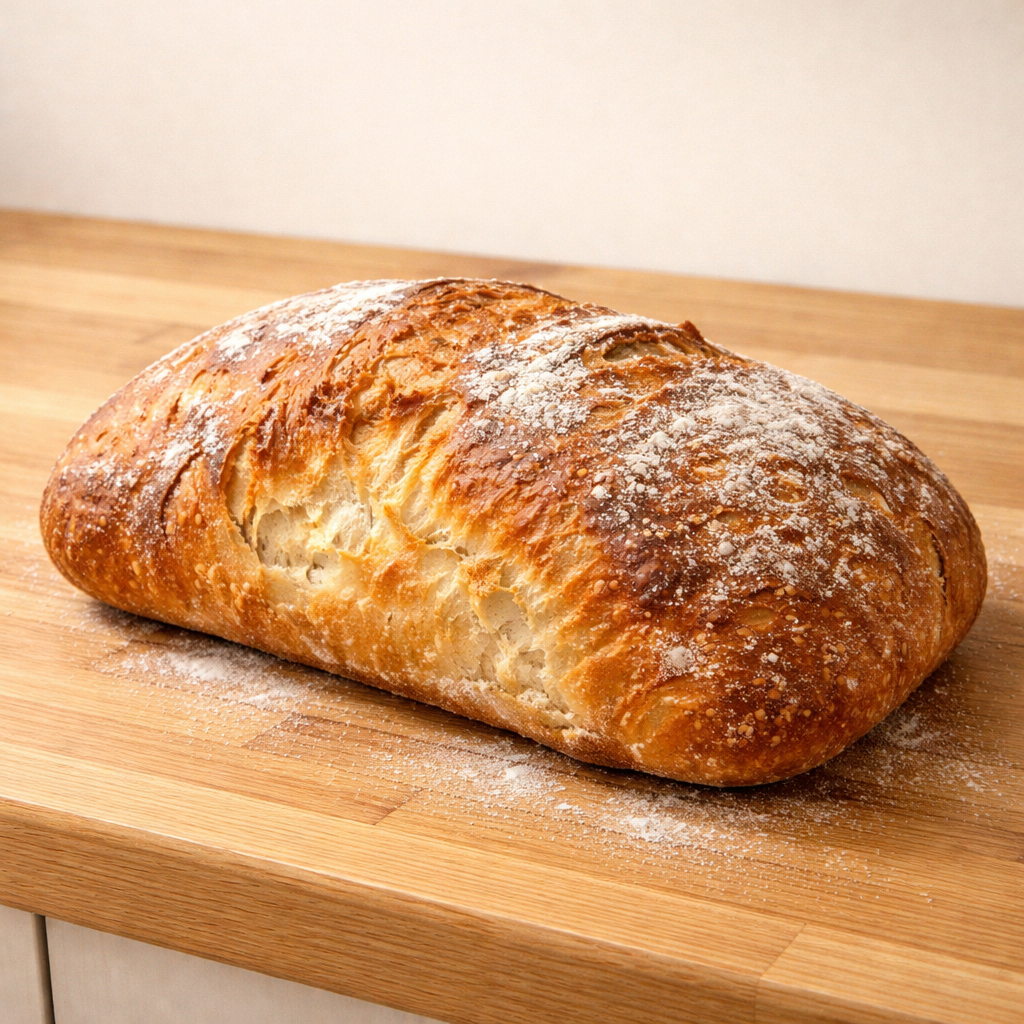
What works now is the rhythm: mix in one bowl, long rise, very gentle shaping, stupidly hot oven, walk away. I barely touch the dough. I do not overthink anything (okay, that part is a lie). The bubbles stay alive, the loaf gets that golden, crusty outside and soft, dramatic holes inside, and I get to feel smug slicing it next to soup.
Is there still some chaos? Of course. Some days the loaf is more oblong than chic. Some days it looks like it was dropped from a low height. But I’m weirdly confident now. Like, 80% sure it’ll be great. Maybe 76%.
What You Actually Need in the Kitchen
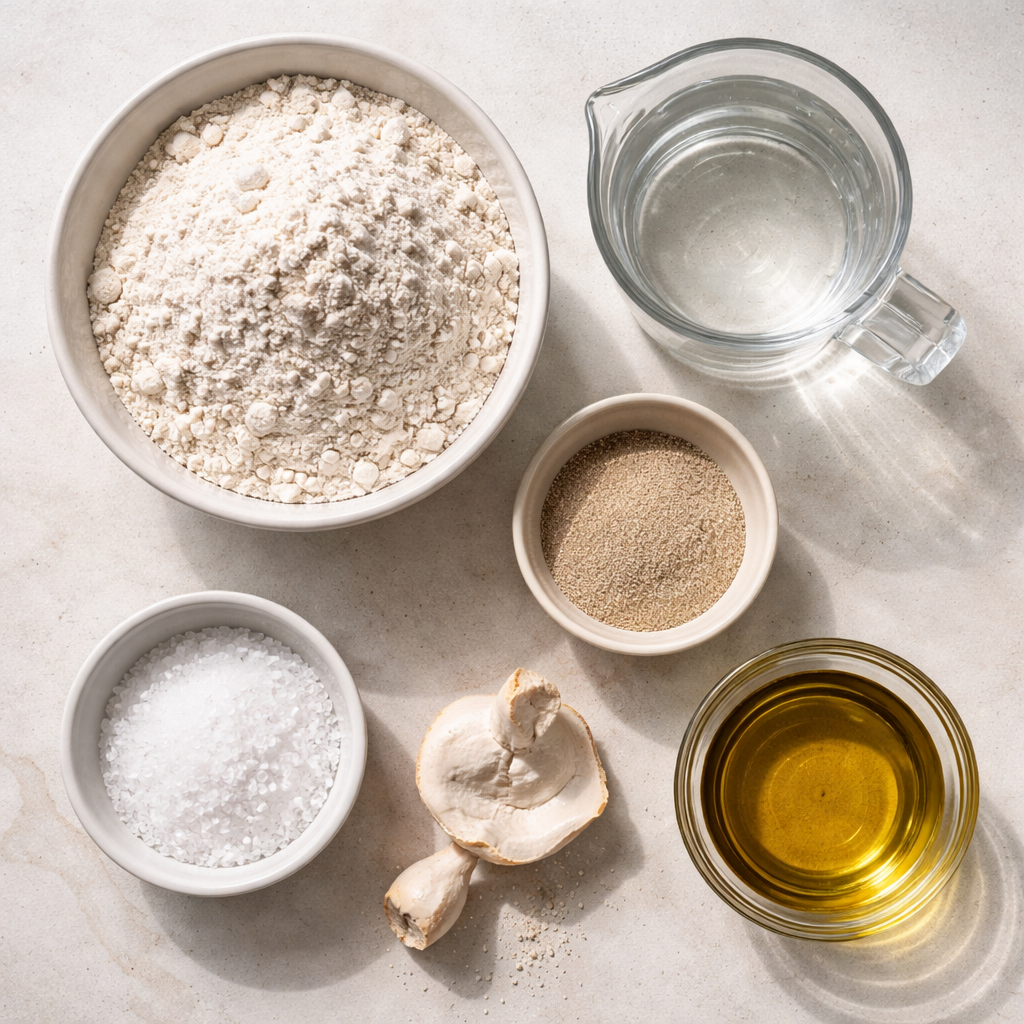
- 4 cups all-purpose flour
- 1 ½ cups water (room temp, not icy, not bathwater)
- 1 teaspoon instant yeast
- 2 teaspoons salt
You can absolutely use the store-brand flour; I do, because I like having money left for butter. The dough is supposed to feel almost wrong—shaggy, sticky, slack. If it looks neat and tidy, something has gone off the rails. Also, yes, you can technically scale this up, but maybe make one loaf before you decide to become the neighborhood bread dealer.
How the Chaos Becomes Bread
- In a large bowl, combine flour, yeast, and salt.
- Gradually add water, mixing until a sticky dough forms.
- Cover the bowl with plastic wrap and let it rise in a warm place for about 2 hours.
- Preheat the oven to 450°F (230°C).
- Dust a workspace with flour and gently pour the dough onto it.
- Shape the dough into a loaf and place it on a baking sheet lined with parchment paper.
- Bake for 25-30 minutes until golden brown and crusty.
- Allow to cool before slicing.
Okay but listen—when I say “mix,” I mean: ugly stir with a spoon until there are no dry flour pockets. It is NOT a smooth ball. If yours is smooth, you’re applying overachiever energy where it’s not wanted. The two-hour rise is approximate; if your kitchen is chilly, it might be closer to 2 ½. If it’s summer and you’re sweating just standing there, watch it after 1 ½ hours.
When you “shape” the dough, think more… gentle nudge into a rectangle/oval blob. Don’t punch it down. Don’t pat it like you’re burping a baby. Just coax it. Flour your hands, but don’t go wild or you’ll dry it out. And for the oven: get it REALLY hot. The brutal temperature is what gives you that dramatic crust. If it looks alarmingly brown at 20 minutes, you’re probably doing amazing.

You, Me, and Flour on Every Surface
Are you also the kind of person who starts a “simple bread recipe” and then realizes mid-mix that you’re out of parchment paper? Because same. I’ve baked this on a lightly oiled pan in a moment of panic and it lived, so if that’s you today, you’re fine.
What are you making this with, by the way? Soup? Olive oil? Just… butter and vibes? The first time I got this right I literally just stood at the counter, ripping off pieces, dipping them in olive oil and salt, and ignoring my family asking when dinner was. (Dinner was bread. They adjusted.)
Also, can we talk about how every recipe online is like, “Your dough should be tacky but not sticky,” and you’re standing there like, “What does tacky mean? My Aunt Linda is tacky. This dough is glue.” If your dough feels too sticky, flour your hands, not the dough. It’s a small difference that feels weirdly personal.
And yes, your kitchen will look like it’s been lightly dusted by a flour tornado. Somehow there is dough on your elbow. Somehow the dog has a little flour mustache now. It’s fine. You’re making something you cannot buy in a plastic bag, and that counts as an accomplishment even if the rest of your day is a trash fire.
If you’re in a baking era right now (respect), I’m just going to quietly recommend that after you master this loaf, you take that confidence and channel it into something like this deeply dramatic chocolate espresso banana bread, which is basically dessert therapy in loaf form.
Questions You’re Probably Already Thinking
Yes, totally. Just dissolve the active dry yeast in the water first and let it sit for about 5–10 minutes until it’s a little foamy, then add that to the flour and salt. If it doesn’t foam, the yeast is dead and you are simply stirring sadness into your bowl, so grab a fresh packet.
Probably not. Ciabatta dough is supposed to be sticky and loose—like “oh no” sticky. As long as it holds together in one mass and you can sort of scoop/pour it out onto the counter, you’re okay. Flour your hands and the surface lightly and try not to smother it in extra flour.
The crust should be deep golden and sound hollow when you tap the bottom of the loaf. If you’re a thermometer person, around 200°F in the center. If you are a vibes-only person, wait until you think “eh, maybe just two more minutes” and then actually give it those two minutes.
You can, but the dough bowl will look like it’s plotting to escape your counter. Use a big bowl, and maybe shape it into two loaves so it bakes evenly. Also: more bread is never a real problem, just a storage question.
Cool it completely, then wrap it in a clean kitchen towel or paper bag and keep at room temp for a day or two. The crust will soften a bit, but a few minutes in a hot oven revives it. If it goes stale, slice it and make croutons or throw it in the freezer. Or, wild idea: just eat it.
I always think I’m going to save half the loaf for tomorrow, and then somehow there are just crumbs and one weird end piece left, sitting on the cutting board like it’s been abandoned at a party. This is the part where I should say something profound about simple rituals and flour and water becoming comfort and all that, but honestly I’m just thinking about whether I have enough butter left for toast in the morning and where I put my favorite knife and—

Ciabatta Bread
This easy homemade ciabatta bread recipe yields a golden, crusty loaf with a soft, open crumb. Perfect for enjoying with soup or simply with olive oil.
Ingredients
For the dough
- 4 cups all-purpose flour Store-brand is acceptable.
- 1.5 cups water Room temperature.
- 1 teaspoon instant yeast Can substitute with active dry yeast.
- 2 teaspoons salt Adjust based on preference.
Instructions
Preparing the Dough
- In a large bowl, combine flour, yeast, and salt.
- Gradually add water, mixing until a sticky dough forms.
- Cover the bowl with plastic wrap and let it rise in a warm place for about 2 hours.
Baking the Bread
- Preheat the oven to 450°F (230°C).
- Dust a workspace with flour and gently pour the dough onto it.
- Shape the dough into a loaf and place it on a baking sheet lined with parchment paper.
- Bake for 25-30 minutes until golden brown and crusty.
- Allow to cool before slicing.
Notes
For the dough, it should feel shaggy and sticky. Adjust rising time based on kitchen temperature. Use a very hot oven for the best crust.